


It is often hard to identify what is driving Donald Trump one month after the US and Israel's campaign of military action on Iran.
But it is clear he has an eye on the oil markets.
A statement – or online message – from the US president concerning his intentions used to spark significant fluctuations in oil prices, as traders seized upon signs the tensions could escalate or de-escalate.
But in the last week, traders are showing signs of growing more doubtful about the significance of his remarks.
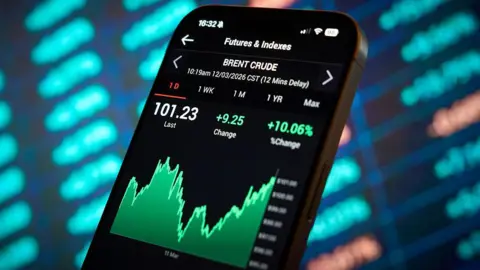
Oil was valued at approximately $72 a barrel (bbl) before 28 February, when the strikes on Iran commenced.
The week prior, it peaked at $118 a barrel on 19 March and by Friday afternoon was sitting at around $112 – markedly up from its pre-conflict price.
Below are several examples from the past month where Trump and the markets seem to have influenced one another – with varying impacts.
Use the navigation button to proceed to the next slide.
"Oil prices have acted as a barometer for broader geopolitical and economic risks, surging when Trump's tone becomes aggressive and declining when his rhetoric de-escalates," observes one market analyst.
He continues that financial markets are appropriately attuned to those cues, given the significant financial dangers that are associated with climbing oil prices.
"Market participants are trying to price genuine uncertainty," he comments. "Markets can seem jumpy or bewildered, but what they're actually doing is handling geopolitical risk in the moment, with oil sitting right at the heart of that."
However, it can be difficult for investors to figure out how to trade, given that a portion of Trump's statements appear intended to influencing oil prices, as opposed to conveying policy, says another market commentator.
"As the saying goes, the first casualty of war is clarity," he observes. "It is likely much of the dialogue trading of statements around productive talks, and the opposite, very much are centred around merely moving the market price of oil."
Market Reactions Grow More Tempered
On Thursday, minutes after US stock markets experienced their sharpest fall since the beginning of the conflict with Iran, Trump stated discussions with Iran were going "extremely well" and he was postponing military strikes on Iran's oil facilities until at least 6 April.
But, the price of crude continued to increase.
One currency strategist points out that market reactions are "growing increasingly subdued" because of the "wide divergence" between Trump's optimistic statements and the lack of response from Tehran.
"Given the appearances, a large number of investors cannot envision an quick conclusion to the conflict and financial markets remain apprehensive."
Another investment director notes markets have also grown used to Trump "repeatedly altering course at indications of political, equity market or economic trouble".
"There is a level of scepticism, or even outright cynicism, taking hold at the fringes," he says.


